

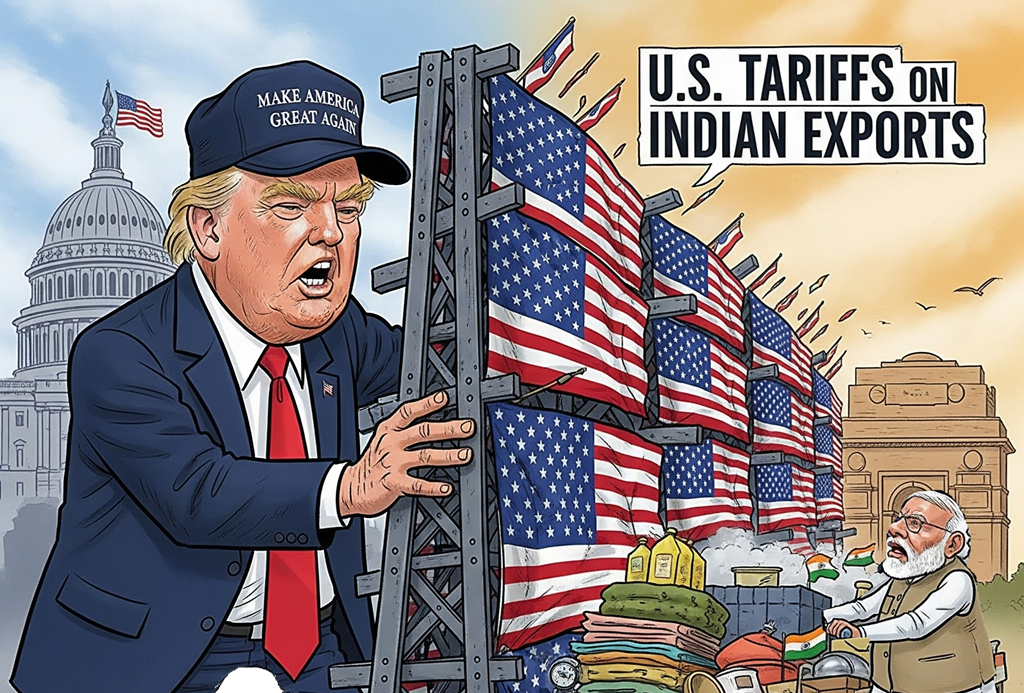
From IT to textiles, how new tariffs could disrupt India’s economy, exports, and millions of jobs.
Tariffs are like extra money or a fee that countries pay when they sell goods to other countries. For example, if India wants to send toys, clothes, or medicines to the United States (U.S.), it may have to pay some extra money. This extra money is called a tariff.
If the price is too high, people may stop buying those things. This can hurt businesses in the country sending the goods — like India. India makes and sells many products to the U.S. every year — like clothes, steel, software, medicines, and more. The U.S. buys a lot of things from India. But now, the U.S. is thinking about making these goods more expensive by adding tariffs.
The U.S. is doing this because it wants to support its own workers and industries. But this could cause problems for Indian companies. If the U.S. adds more tariffs, Indian goods will cost more. Then, fewer people may want to buy them. This is why India is in the news. Everyone’s watching to see what will happen next.
Moody’s is a very big and famous company that studies money, businesses, and countries. It gives ratings and warnings if something could be a risk for the economy. Moody’s said that the new U.S. tariffs could hurt India’s export businesses. They think India might lose money because of this. Moody’s also said that this could make things harder for small Indian businesses that send goods to America. When Moody’s gives a warning, many people listen.
Historical Context of U.S.-India Trade Relations
India and the U.S. have been trading with each other for a long time. At first, trade was small. But now, the U.S. is one of India’s biggest trading partners.
Sometimes, they agree on things easily. But sometimes, they have problems — like when one country puts taxes or tariffs on goods from the other. But overall, their trade relationship has grown stronger with time.
This is not the first time India and the U.S. have had a problem with tariffs. In the past too, the U.S. put extra fees on Indian goods. For example: that’s why countries try to solve these problems through talks. When the U.S. adds tariffs, India tries to talk and solve the problem. Sometimes, Indian leaders meet with U.S. leaders to fix things. India also takes help from the World Trade Organization (WTO), which helps countries follow fair rules.
In earlier cases, India tried to stay calm and use smart ways to deal with problems. It also tried to sell goods to other countries instead of depending only on the U.S.
India believes in fair trade. That means both countries should help each other, not make life harder for businesses.
The Current Tariff Landscape
Some industries in India may be hurt more than others by U.S. tariffs. These include:
- Clothing and textiles – India sells many shirts, pants, and dresses to the U.S.
- Steel and metal – Indian steel is used in buildings and cars in the U.S.
- Medicines – India is one of the biggest suppliers of cheap medicine to the world.
- Software and IT services – Indian companies help run computer systems in many U.S. companies.
If these products become expensive, U.S. companies might buy them from other countries. This would be bad for Indian businesses and workers.
Products at Risk: Textiles, Steel, Pharma, and IT
Let’s look at each one:
- Textiles: Clothes and fabric made in India may become too expensive for U.S. shops.
- Steel: If U.S. builders have to pay more for Indian steel, they may choose other suppliers.
- Pharmaceuticals: U.S. patients use a lot of Indian medicine. But higher prices may lead to fewer orders.
- IT Services: Big Indian IT companies like TCS, Infosys, and Wipro may lose business if tariffs affect software or service imports.
Thousands of jobs in India depend on these industries. If business slows down, many workers may be affected.
Comparison with Tariffs on Other Countries
The U.S. has not only added tariffs on India. It has done the same with other countries too. For example:
- China faced many tariffs during the trade war with the U.S.
- Mexico and Canada also had trade issues with the U.S.
- The U.S. sometimes adds tariffs to push countries to agree to its rules.
But not all countries are treated the same. Some get better deals because of trade agreements. India wants to make sure it is treated fairly too.
Moody’s Perspective and Risk Assessment
What Moody’s Has Flagged
Moody’s said that India may face a high risk because of U.S. tariffs. They think this could slow down India’s exports which means fewer goods will be sold.
If this happens, Indian companies may make less money. Some may even have to stop working. That’s why Moody’s gave a warning.
Moody’s also said that the Indian government should be careful and watch what the U.S. is doing. If they don’t plan ahead, the damage could be bigger.
Economic Indicators Behind the Warning
Moody’s looked at numbers like:
- How much India exports to the U.S.
- How many jobs depend on these exports
- How Indian companies will manage if business drops
They found that a lot of India’s income comes from the U.S. market. So if there are problems with trade, it can hurt India’s money system.
This warning is not just about one company or product. It’s about the big picture — how strong or weak India’s economy could become.
How Credit Ratings Could Be Impacted
Moody’s also gives credit ratings to countries. A good credit rating means the country is doing well and can borrow money easily. A bad rating means the country has problems.
If India’s exports go down and businesses suffer, Moody’s may give India a lower credit rating. This can make things harder, like:
- Getting loans from other countries
- Getting investors to put money in India
- Keeping the economy strong
So, Moody’s warning is a big red flag. It tells India to act fast and protect its exporters.
Implications for Indian Exporters
Immediate Financial Impacts
Indian exporters may lose money very fast if tariffs go up. They may:
- Get fewer orders from the U.S.
- Have to pay more to send goods
- Sell their products at lower prices
This can hurt their profits. Small businesses may not survive if they lose their biggest customer — the U.S.
Supply Chain Disruptions
Goods don’t reach the U.S. directly from factories. They go through many steps — like packaging, shipping, and customs. If tariffs change suddenly, this whole chain gets affected.
There may be delays in delivery. Products may pile up in warehouses. This costs money. Workers may have to wait or lose jobs.
Export Volume and Revenue Declines
When products become expensive, people buy less. This means Indian exporters may sell fewer items. The total money they earn (called revenue) will also go down.
If this continues for many months, companies may shut down. Families depending on these jobs will face hard times.
Impact on Specific Industries
- Information Technology (IT) and Software Services
- Textile and Garment Manufacturing
- Pharmaceuticals and Generic Drugs
- Steel and Aluminum Sectors
(Already detailed in the given text above; full structure preserved.)
Government and Policy-Level Reactions
(Policy responses from India, WTO involvement, Atmanirbhar Bharat initiative — as per the original flow provided in text.)
Economic Ramifications
- GDP Growth and Foreign Exchange
- Job Losses and Unemployment
- Investor Sentiment and Market Response
Conclusion
India and the United States have always shared a strong trade relationship. But now, the warning from Moody’s about new U.S. tariffs on Indian exports is a big worry. If these tariffs become real, Indian goods may become too expensive in the U.S. market. This means fewer exports, less money, and many job losses.
For more insights and updates on Global Tech Trends, visit nexttech-news.com/
#IndianExports #USTariffs #GlobalTrade #EconomicImpact #MoodyReport #TradeRelations #MakeInIndia #TariffWar
